
Payment gateway charges in Nepal: read the whole merchant quote
Compare setup, transaction, refund and settlement terms without relying on a universal merchant fee percentage.
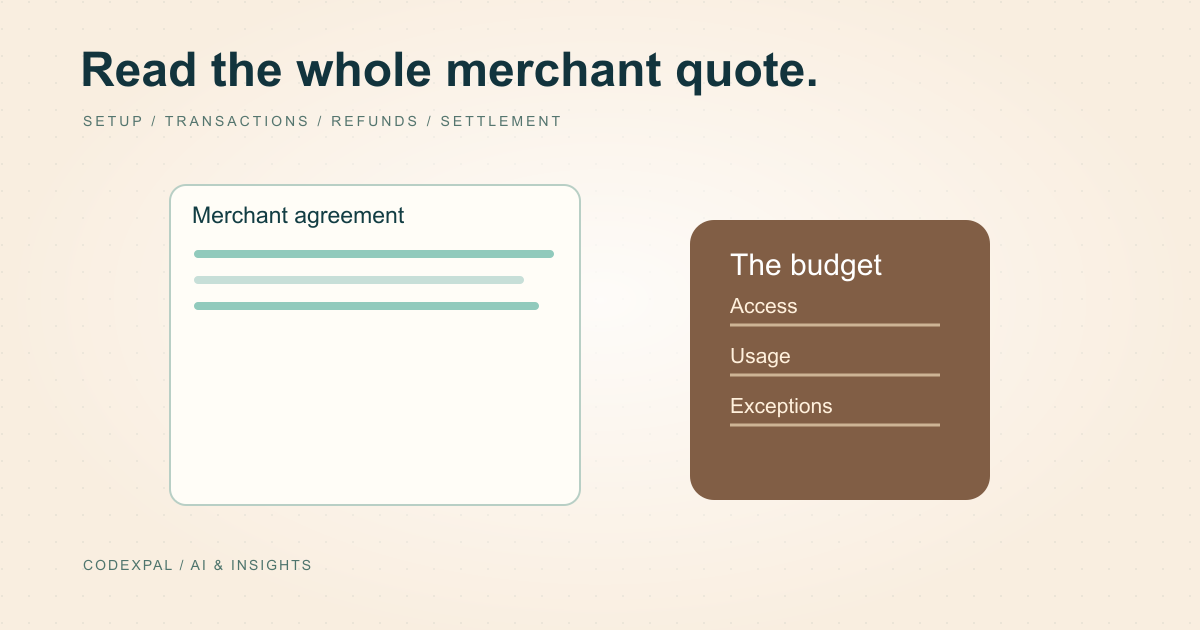
A single percentage rarely describes an entire payment arrangement. Ask for a written quote that names the exact product, merchant type and services included. This guide provides a comparison worksheet rather than a price list or a promise about settlement timing.
Name the service being priced
A static QR acceptance arrangement, dynamic QR integration, hosted web checkout and a custom acquiring contract can be different offers. A statement about one should not be extended to every API, bank or channel.
Check the provider’s current public information and ask for clarification where the commercial quote differs. For example, a provider FAQ about QR acceptance should be read in that context, not treated as a universal statement about all implementation and operating costs.
Reference: Fonepay — current provider FAQs
Build a quote comparison table
Record the effective date and the contact who supplied each term. Ask which amounts are fixed, which depend on transaction volume and which are collected by another party. Include the work your own team must do to integrate and maintain the system.
| Cost or term | Question for the provider |
|---|---|
| Setup and access | What is charged once, and what access is included? |
| Transactions | Is there a percentage, fixed amount, minimum or tier? |
| Refunds and reversals | Which charges are returned, retained or added? |
| Settlement | When and how are funds paid out, and what exceptions apply? |
| Taxes and statements | What appears on the invoice and settlement report? |
Use an explicit budgeting example
For an invented quote, suppose monthly access costs 500 units and each of 200 transactions costs 2 units. The simple base total is 900 units before any other charges. These numbers demonstrate the arithmetic; they are not current fees for a Nepal payment provider.
Repeat the calculation using your expected transaction mix and the actual contract. A low headline percentage can still be the wrong comparison if minimum charges, refund behaviour or operational effort differ.
Agree on reporting and exceptions
Ask how to obtain transaction and settlement records, how refunds are referenced and how to escalate an unmatched payment. A predictable support route is part of the operating decision.
Keep the signed terms and later amendments with your integration records. Do not publish a third-party quote as a universal market rate. Recheck it when the provider, bank, product or contract changes.
The takeaway
Compare a dated, product-specific agreement and your expected workload. Avoid universal fees or next-day settlement assumptions that the provider has not confirmed for your account.
Sources & further reading
Primary references checked on October 18, 2026. Examples and diagrams are illustrative unless stated otherwise.
More to think about.

How to manage retail inventory: a practical starting system
Build a usable stock register, separate sales from adjustments, and use a simple replenishment worksheet before automating your shop.
From an offline shop to an online store: a practical roadmap
Separate being discovered from taking orders, accepting payments and fulfilling them. Start with one complete customer journey.