
Reduce LLM costs by measuring the work, not guessing
A practical method for finding unnecessary context, retries and repeated work without sacrificing the quality users depend on.
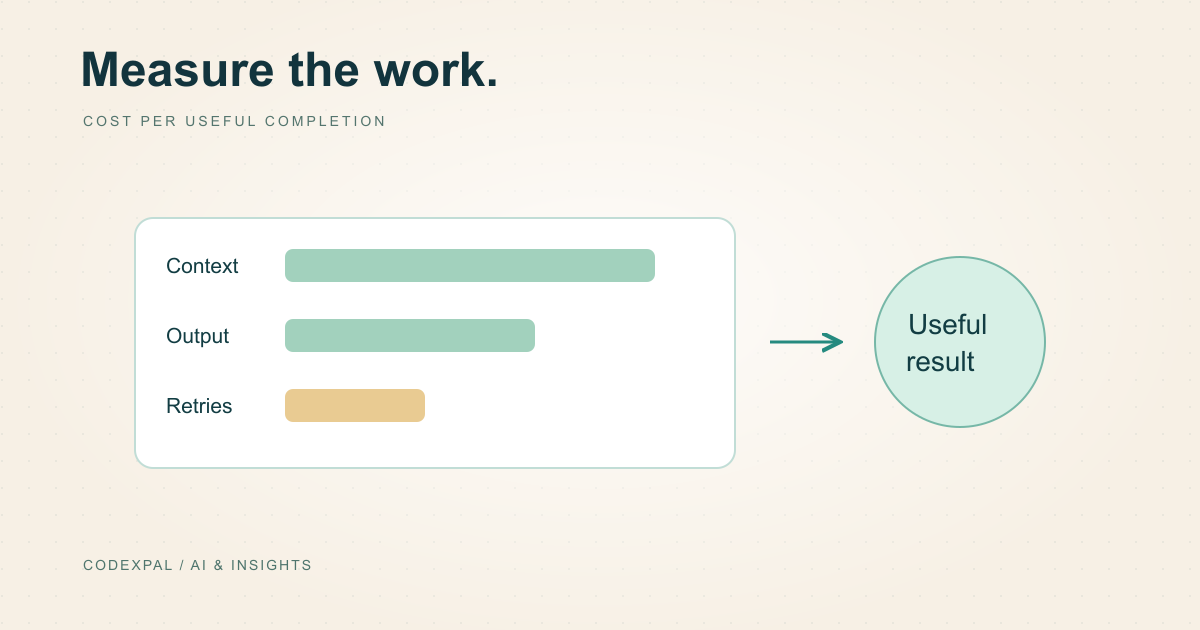
A low price per token does not necessarily produce a low cost per completed task. A cheap request that fails repeatedly may cost more than a slightly more expensive one that resolves the user’s problem. Start by measuring the actual workflow: context sent, output generated, tool calls, retries and whether the task was completed usefully. Then optimize the part responsible for avoidable work.
Define a useful unit of cost
For a support assistant, the unit might be a correctly answered request with an appropriate source. For a document feature, it might be an accepted summary. Count failed attempts and retries as part of the same task, instead of reporting only the cost of the final successful call.
Keep provider token charges separate from retrieval, storage, hosting and human review. Local inference may avoid per-request provider billing but still uses hardware, electricity and operational time. The right comparison depends on the workload you actually need to run.
Write down a transparent estimate
Use the provider’s current rates and units for the exact model and request type. The example below is a generic arithmetic helper. Its rates are deliberately fictional placeholders in currency units per million tokens; they are not a quote for any provider or model.
The helper also excludes cache writes, cache reads, tools and other fees. Expand your accounting only when those costs apply. Record the rate source and date beside an estimate so someone can reproduce it when the pricing changes.
def estimate(input_tokens, output_tokens, input_rate, output_rate):
    """Rates are fictional currency units per million tokens."""
    return (input_tokens * input_rate + output_tokens * output_rate) / 1_000_000

# An arithmetic example, not provider pricing:
example = estimate(2000, 500, 1.0, 4.0)
assert abs(example - 0.004) < 1e-12
print(f"Illustrative token charge: {example:.3f}")
Remove context that does not help the task
Inspect real requests. A short classification task may not need the whole conversation and every retrieved document. Send the relevant policy passage, not an entire handbook by default. Keep essential facts in application state so summarizing a conversation does not lose the one identifier that matters.
Measure quality after each reduction. A smaller context that removes a crucial exception can make the system less useful. For retrieval, compare source coverage as well as token usage; the goal is focused evidence, not the shortest possible prompt.
A request budget you can inspect
- 01ContextNecessary input only
- 02OutputA useful response length
- 03RetriesBounded recovery
- 04OutcomeCost per useful completion
Cache the right thing with the right scope
Some providers offer prompt caching for eligible repeated input. Eligibility, cache behavior and billing depend on the specific API. Read the current documentation rather than assuming repeated text is automatically free.
Application-level response caching is a separate decision. Only reuse a response when its user scope, source version and freshness requirements match. A cache key that ignores authorization can turn an optimization into a data leak. Start with stable public content or tightly scoped results you can invalidate deliberately.
Reference: Anthropic — Prompt caching
Route simple work and stop needless loops
A deterministic calculation should usually stay a calculation. A simple lookup should not become several rounds of model reasoning. For model-based tasks, compare a smaller candidate against your existing quality baseline before routing traffic to it.
Bound retries and distinguish transient transport failures from invalid input. Repeating a request unchanged will not fix a missing order number. Record why a task retried and whether recovery helped. A latency or usage field from a local service can inform measurement, but it is not a monetary invoice.
Reference: Ollama — Chat response usage fields
The takeaway
Optimize cost per useful result. Measure the workflow, remove unnecessary work, scope caches carefully and compare every change against quality. Use dated provider pricing for real estimates, never numbers copied from an undated tutorial.
Sources & further reading
Primary references checked on October 18, 2026. Examples and diagrams are illustrative unless stated otherwise.
More to think about.
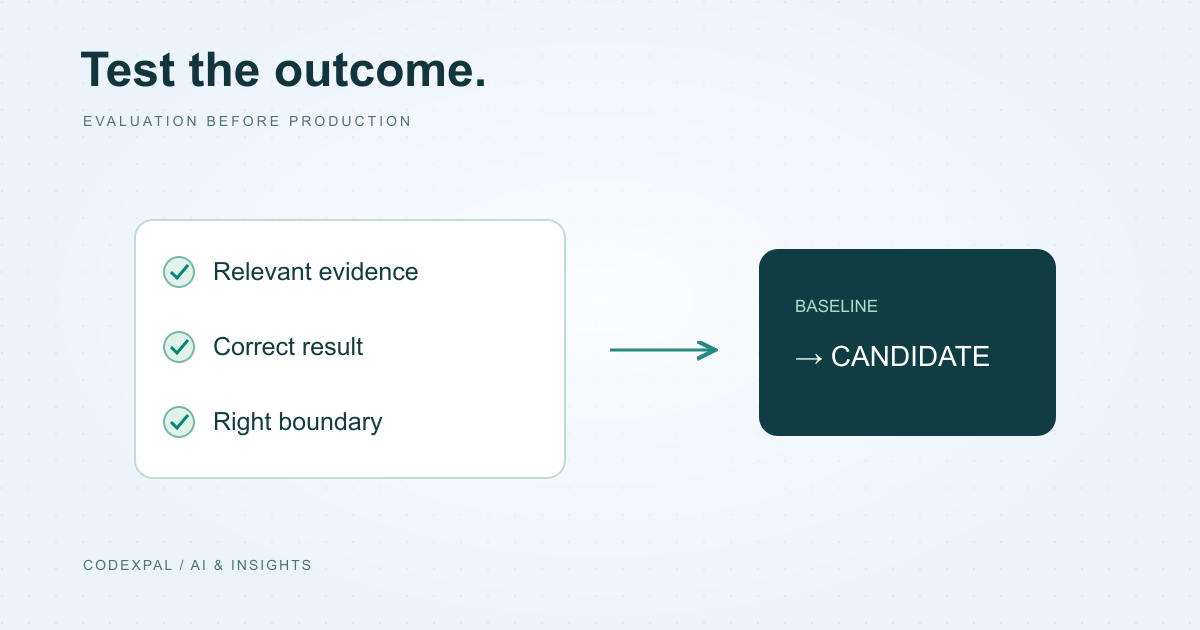
How to evaluate an AI application before production
Build a small, repeatable evaluation set that checks useful outcomes, factual support, boundaries, latency and cost.

PHP2Shell and “Black October”: what AI-found vulnerabilities mean for every language
AI models helped find two unauthenticated remote-code-execution flaws in PHP’s core engine, the runtime behind up to 70% of websites. Attacks began within minutes. What happened, why npm and PyPI face the same pressure, and what every team should change.