
AI model deprecations and price changes: keep your app from breaking
Providers retire model names, reroute old ones and publish price increases. Recent examples and a simple process for staying ahead of them.
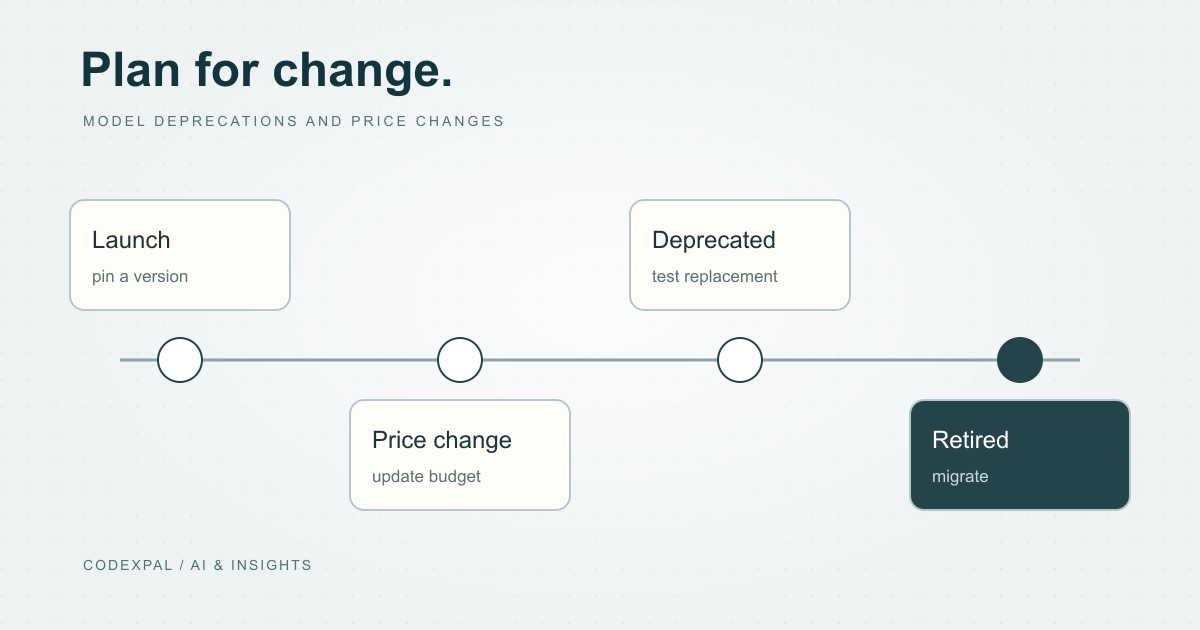
AI APIs change faster than most software dependencies. A model you integrated last year may now be deprecated, routed to a different model, or scheduled for a price increase. The examples below come from providers’ pricing pages as checked on November 12, 2026.
Recent examples
Google lists Gemini 2.5 Pro and Gemini 2.5 Flash as deprecated. From December 1, 2026, their requests route to Gemini 3.8 Flash and Gemini 3.5 Flash-Lite respectively, and are billed at those models’ rates. The same page lists Gemini 4 Carbon’s rates doubling from December 1, 2026, and Gemini 3.8 Flash’s from January 1, 2027.
DeepSeek notes that its legacy deepseek-v4-flash names still work, but the underlying models are retired and requests are served and billed as DeepSeek V4.1 Flash. Anthropic lists several older Claude models as retired on its own API but still available on some cloud platforms.
Reference: Google — Gemini API pricing · DeepSeek — API models and pricing · Anthropic — Claude API pricing · Anthropic — model deprecations
Why rerouting is a risk
When an old model name is silently served by a newer model, your code keeps running, but output style, length, accuracy and cost can all change. A prompt tuned for one model may behave differently on its replacement.
A simple lifecycle process
Treat models as versioned dependencies with an owner and a review date.
Keep model changes under control
- 01PinUse a specific model version in production
- 02WatchSubscribe to deprecation and pricing notices
- 03TestRe-run your evaluation set on the replacement
- 04MigrateSwitch with a rollback plan and new budget
Budget for scheduled increases
When a provider publishes a future price, update your forecast immediately. Our model price comparison shows published scheduled changes beside the current rate. If an increase makes a feature uneconomic, test a smaller model or add caching before the date arrives.
The takeaway
Pin versions, track notices, keep an evaluation set and update cost forecasts when prices are announced. Model changes then become planned work instead of production incidents.
Sources & further reading
Primary references checked on November 12, 2026. Examples and diagrams are illustrative unless stated otherwise.
More to think about.
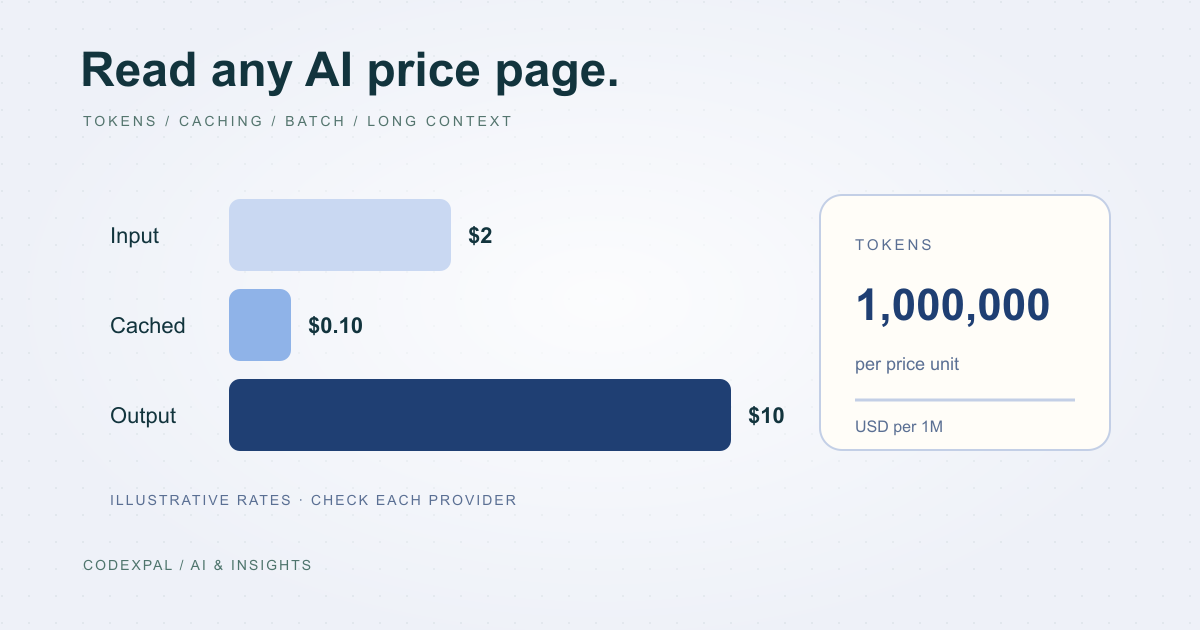
AI API pricing explained: tokens, caching, batch and long context
How OpenAI, Claude, Gemini, DeepSeek and Mistral charge for API use, why output costs more than input, and the four modifiers that change your real rate.
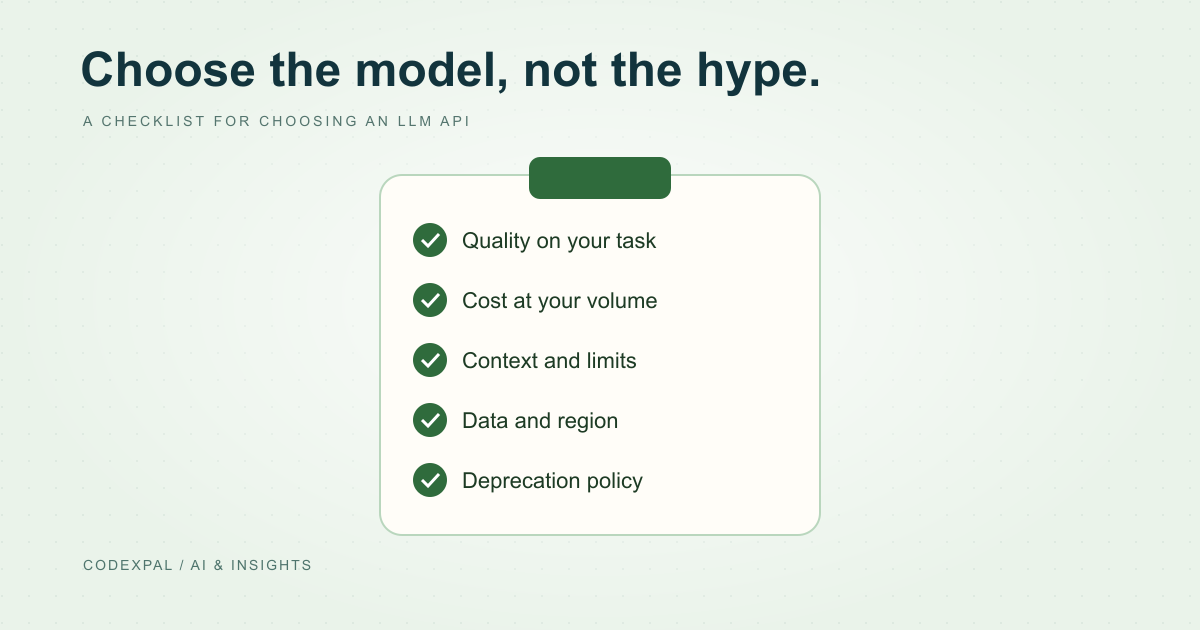
Choosing an LLM API: a practical checklist for developers
Price per token is one line on the list. Test quality on your own task, then check context, limits, data handling, regional pricing and how the provider retires models.